

Overview
-
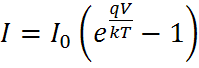
- I0 is directly related to recombination, and thus, inversely related to material quality.
- Non-ideal diodes include an "n" term in the denominator of the exponent. N is the ideality factor, ranging from 1-2, that increases with decreasing current.
Ideal Diodes
The diode equation gives an expression for the current through a diode as a function of voltage. The Ideal Diode Law, expressed as:
$$I=I_{0}\left(e^{\frac{q V}{k T}}-1\right)$$
where:
I = the net current flowing through the diode;
I0 = "dark saturation current", the diode leakage current density in the absence of light;
V = applied voltage across the terminals of the diode;
q = absolute value of electron charge;
k = Boltzmann's constant; and
T = absolute temperature (K).
The "dark saturation current" (I0) is an extremely important parameter which differentiates one diode from another. I0 is a measure of the recombination in a device. A diode with a larger recombination will have a larger I0. An excellent discussion of the recombination parameter is in 1
Note that:
- I0 increases as T increases; and
- I0 decreases as material quality increases.
At 300K, kT/q = 25.85 mV, the "thermal voltage".
Non-Ideal Diodes
For actual diodes, the expression becomes:
$$I=I_{0}\left(e^{\frac{q V}{n k T}}-1\right)$$
where:
n = ideality factor, a number between 1 and 2 which typically increases as the current decreases.
The diode equation is plotted on the interactive graph below. Change the saturation current and watch the changing of IV curve. Note that although you can simply vary the temperature and ideality factor the resulting IV curves are misleading. In the simulation it is implied that the input parameters are independent but they are not. In real devices, the saturation current is strongly dependent on the device temperature. Similarly, mechanisms that change the ideality factor also impact the saturation current. Temperature effects are discussed in more detail on the Effect of Temperature page.
Changing the dark saturation current changes the turn on voltage of the diode. The ideality factor changes the shape of the diode. The graph is misleading for ideality factor. It implies that increasing the ideality factor would increase the turn on voltage. In reality this is not the case as any physical effect that increases the ideality factor would substantially increase the dark saturation current, I0, so that a device with a high ideality factor would typically have a lower turn on voltage.
The diode law is illustrated for silicon on the following picture. Increasing the temperature makes the diode to "turn ON" at lower voltages.
The diode law for silicon - current changes with voltage and temperature. For a given current, the curve shifts by approximately 2 mV/°C. The light blue curve shows the effect on the IV curve if I0 does not change with temperature. In reality, I0 changes rapidly with temperature resulting in the dark blue curve.
- 1. , “The Recombination Parameter J0”, Energy Procedia, vol. 55, pp. 53 - 62, 2014.