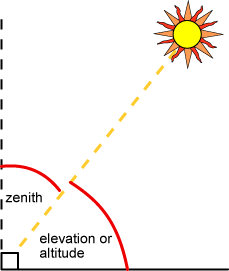
Elevation Angle
The elevation angle (used interchangeably with altitude angle) is the angular height of the sun in the sky measured from the horizontal. Confusingly, both altitude and elevation are also used to describe the height in meters above sea level. The elevation is 0° at sunrise and 90° when the sun is directly overhead (which occurs for example at the equator on the spring and fall equinoxes). The zenith angle is similar to the elevation angle but it is measured from the vertical rather than from the horizontal, thus making the zenith angle = 90° - elevation.
The elevation angle varies throughout the day. It also depends on the latitude of a particular location and the day of the year.
An important parameter in the design of photovoltaics systems is the maximum elevation angle, that is, the maximum height of the sun in the sky at a particular time of year. This maximum elevation angle occurs at solar noon and depends on the latitude and declination angle as shown in the figure below.
The maximum elevation angle at solar noon (α) is a function of latitude and the declination angle (δ).
From the previous figure, a formula for the elevation angle at solar noon can be determined according to the formula for locations in the Northern Hemisphere:
and for the Southern Hemisphere:
where:
φ is the latitude of the location of interest. In the equation for the Northern Hemisphere, it is positive for Northern Hemisphere locations and negative for Souther Hemisphere. In the equation for the Southern Hemisphere, φ is postive for Southern Hemisphere locations and negative for Northern Hemisphere locations.
δ is the declination angle, which depends on the day of the year.
At the Tropic of Cancer on summer solstice, the sun is directly overhead and the elevation angle is 90°. In summer at latitudes between the equator and the Tropic of Cancer, the elevation angle at solar noon is greater than 90°, implying that the sunlight is coming from the north rather than from the south as in most of the northern hemisphere. Similarly, at latitudes between the equator and the Tropic of Capricorn, during some periods of the year, sunlight is incident from the south, rather than from the north.
While the maximum elevation angle is used even in very simple PV system design, more accurate PV system simulation requires the knowledge of how the elevation angle varies throughout the day. These equations are given in the following page.
The elevation can be found using the following formula:
The zenith angle is the angle between the sun and the vertical.
zenith = 90° - elevation.
Sunrise and Sunset
To calculate the sunrise and sunset time the equation for elevation is set to zero and the elevation equation
and sunset:
these equations can be simplified as:
Comments
Elevation Angle
Elevation Angle
Reason: Edit
- stuartb
- Registered User
- Posts: 28
- Joined: 24 Jul 2011, 11:42
Re: Elevation Angle
- MySchizoBuddy
- Registered User
- Posts: 30
- Joined: 20 Aug 2010, 06:03
Re: Elevation Angle
MySchizoBuddy wrote:it should be "Φ is the latitude of the location of interest"
Corrected. Thanks.
-
pveducation
- Site Admin
- Posts: 200
- Joined: 12 Jul 2010, 19:14
- Location: Tempe AZ, USA
Re: Elevation Angle
I'm thinking not cause it contains the TC term, so this formula belongs to a different algorithm
- MySchizoBuddy
- Registered User
- Posts: 30
- Joined: 20 Aug 2010, 06:03
Re: Elevation Angle
Inputs: April 1st, 15:00, Latitude=27 Longitude=-98 and GMT offset=-6
The answer produced by the calculator is 18:45 but when I work through the equation provided I get 18:28. I've also tried other inputs and always the sunset is off, sometimes by more than an hour. The minutes appear to always copy the sunrise minutes. Please let me know if there is an error in this equation. Thank You!
~Emily
- Emily
- Registered User
- Posts: 2
- Joined: 30 Mar 2011, 12:59
Re: Elevation Angle
The result you are getting is in DECIMAL Hours 18.45 which is 18:28 in real time.
Hope that helps.
- Peterwood
- Registered User
- Posts: 1
- Joined: 12 Aug 2011, 09:10
Re: Elevation Angle
I have read and evaluated the formulas here to calculate the sun's position at any given time and also to calculate the sunrise and sunset times on a given day. That does not mean that I understand mathematics completely - I have merely converted the formulas into a spreadsheet to verify correct evaluation and then converted to code for operation.
I can post the spreadsheet if anyone is interested.
I am building a control circuit for a solar tracking PV array. The tracker is being designed to move 3 degrees periodically. I am using a PicAxe 40X2 micro controller to manage the electric motors and condition sensing (Invertor over current, wind, Limit switch, array bearing). I have put the sun position calculations into a uM-FPU co-processor with some other supports functions like converting the degrees, minutes and seconds into decimal degrees.
I would like to be able to calculate when the sun will reach a specific elevation or azimuth bearing in advance so that I can control the sleep time of the processor and reduce power consumption. on the Elevation page it is stated that
To calculate the sunrise and sunset time the equation for elevation is set to zero
Is it possible to modify the sunrise/set formula to determine when the sun will reach a given elevation other than the horizon... ie: multiples of 3 degrees? I don't understand where the zero is in the sunrise/set formula
Alternately is it possible to calculate when the sun will reach a particular azimuth bearing.. once again in multiples of 3 degrees between 240 and 120 - the maximum bearings at summer soltice for our location?
Regards,
Linzmeister
- Linzmeister
- Registered User
- Posts: 1
- Joined: 08 Sep 2011, 20:12
Re: Elevation Angle
According to me there is a mistake in the formula for calculating the sunset.
In the formula for sunrise there is a minus-symbol between the brackets. That symbol is omitted in the formule for the sunset. If you adapt the formula, you'll get the exact value
Kind regards
Raymond
- Raymond
- Registered User
- Posts: 1
- Joined: 23 Oct 2011, 12:22
Re: Elevation Angle
Thanks so much for your reply - you are correct, the sunset formula is missing the minus sign within the parentheses. I appreciate your help!
Best,
Emily
- Emily
- Registered User
- Posts: 2
- Joined: 30 Mar 2011, 12:59
Re: Elevation Angle
Emily wrote:Hi Raymond,
Thanks so much for your reply - you are correct, the sunset formula is missing the minus sign within the parentheses. I appreciate your help!
Best,
Emily
Thankyou both for contributing. I have made the correction as you suggested.
- stuartb
- Registered User
- Posts: 28
- Joined: 24 Jul 2011, 11:42